-
Be Human First
Facts, Faith, and Freedom in Aotearoa New Zealand
We calmly address misinformation, hostility, and fear-based narratives directed at the Sikh community. It does not exist to provoke, threaten, or attack any individual or belief. Its purpose is to present facts, historical context, and lived reality so that public discussion can be grounded in truth rather than hate or fear.
Cultural and religious expressions are protected in Aotearoa New Zealand because they enrich society, not because they can be used to silence others. When any sacred practice whether haka, scripture, or symbol is repurposed to intimidate a peaceful community, it ceases to serve its highest purpose. A strong society protects both cultural dignity and religious freedom, without allowing either to be used as a weapon against the other.
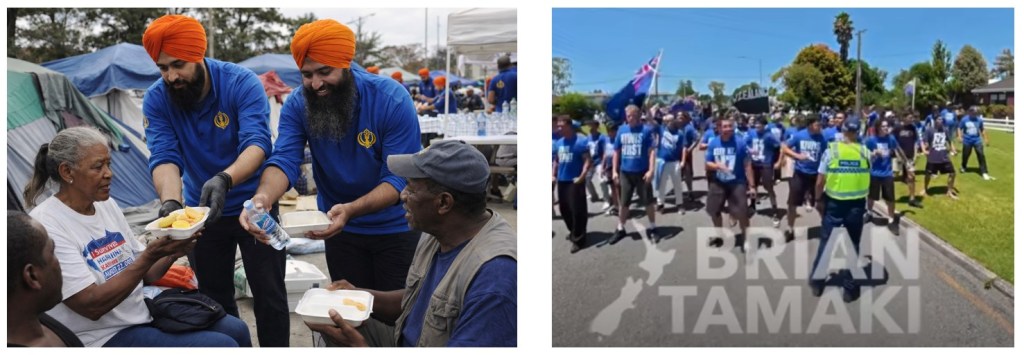
A group of individuals disrupted Sikh religious events by performing a haka on:
- South Auckland 23 December 2025
- Tauranga 11 January 2026
These actions occurred during lawful, permitted religious processions and caused distress within the community and among members of the public who were present. Performing a haka in such a manner, directly in front of such a procession, particularly when the stated aim is opposition or “resistance”, changes the haka’s function from cultural expression to a tool of confrontation. This is not a criticism of haka itself. It is a concern about how it is being used.
Many Māori leaders and commentators have publicly stated over the years that the haka should not be weaponised or misused to intimidate others, especially in non-consensual or politically charged contexts.
Peaceful Faith, Not Provocation
Recent public commentary and online behavior has shown that some individuals and groups have deliberately targeted Sikhs through inflammatory language, misrepresentation of religious symbols, and collective blame. These actions have included attempts to interrupt peaceful religious processions, online harassment, and rhetoric suggesting that Sikhs are a threat to public safety or national identity.
The Sikh response to such targeting has not been violence, retaliation, or intimidation. Sikh teachings emphasise restraint, dignity, and trust in justice. Sikhs do not seek confrontation in the streets or online. They rely on the rule of law, democratic institutions, and lawful authorities to address wrongdoing where it exists.
Sikh philosophy is clear: justice must be pursued through righteous means. There is no teaching within Sikhism that permits harming innocent people, provoking unrest, or undermining civil order.
Lawful Processions.
Sikh religious processions (Nagar Kirtans) have been held peacefully in New Zealand for many years across different regions. These events are annual, not frequent, and typically last approximately 4 to 5 hours once per year in any given location. Each year, organisers:
- Obtain all required legal permits and approvals
- Coordinate with local councils, police, and relevant authorities
- Follow established public safety and traffic management requirements
These processions are family-oriented, prayer-focused, and non-political. They are not intended to impose Sikhism or Indian culture on anyone, only to celebrate it.
What Sikhs Were Chanting during the procession when challenged with the haka.
Bole So Nihal, Sat Sri Akal is a declaration of faith and a greeting used by Sikhs worldwide. It means, “Whoever proclaims ‘Sat Sri Akal’ shall be fulfilled or blessed.” “Sat” means Truth. “Akal” means Timeless. The message is simple and universal: God is Truth, and Truth is Timeless.
This chant is not a political slogan, not a challenge to other religions, and not a claim of superiority. It is a statement of faith centred on truth, humility, and moral living.
Teachers, Not Gods
In Sikh belief, God is formless, timeless, and beyond human incarnation. Figures such as Guru Nanak and Guru Gobind Singh are revered as spiritual teachers and guides, not as God. Similarly, Sikhism recognises figures such as Jesus Christ and Muhammad as teachers and messengers within their own traditions. This theological position is an explanation of Sikh belief, not a judgement of other faiths. In fact, Sikhism and Christianity believe in the one God, and Sikhism recognises Jesus as a prophet; our beliefs are the same.
The Kirpan: Symbol of Responsibility
The kirpan is one of the five articles of faith worn by initiated Sikhs. It symbolises the duty to protect the vulnerable, stand against injustice, and live with moral discipline. In modern practice, kirpans are typically small, secured, and ceremonial. There is no credible evidence or historical record of Sikhs using the kirpan as a tool for mass violence, terrorism, or public harm in New Zealand. Globally, Sikhs are recognised as one of the most law-abiding religious communities.
Sikh History and Global Conduct
Throughout history, Sikhs have not engaged in campaigns of ethnic cleansing or religious genocide. On the contrary, Sikh history is defined by resistance to oppression, protection of minorities, and defence of religious freedom including for those of other faiths.
Sikh tradition explicitly rejects forced conversion, religious supremacy, and collective punishment. Historical conflicts involving Sikhs have been defensive in nature, arising from persecution or the need to protect civilians, not to dominate or erase other communities.
Community Inclusion and Hospitality
A defining feature of Sikh processions is open hospitality. Refreshments and food are freely provided to:
- Local residents
- Members of the public
- Passers-by
- People who step out of their homes to observe the procession
No person is excluded, questioned, or required to share any belief. Many members of the wider community including people from diverse cultural and religious backgrounds have consistently expressed appreciation and support for these events.
Sikhs in New Zealand
Sikhs have lived in New Zealand for over a century. They work, pay taxes, raise families, and contribute across sectors including agriculture, transport, healthcare, construction, and small business. In times of crisis, Sikh communities have consistently provided food, shelter, and support to anyone in need, without regard to religion or background, and with absolutely no need or desire to promote themselves for it.
Sikh Contribution in World War I and II
Sikhs made significant contributions during both World War I and World War II, serving in large numbers across the British and Commonwealth forces. Despite being a small global population, Sikhs were disproportionately represented in frontline combat roles.
During World War I, over 100,000 Sikhs served, with tens of thousands killed or wounded. They fought in Europe, the Middle East, Africa, and Gallipoli. In World War II, Sikh soldiers again served across multiple theatres, earning numerous gallantry awards for bravery and sacrifice.
These soldiers did not fight to impose their religion. They fought to defend freedom, resist tyranny, and protect civilian population’s values that align closely with the principles they continue to live by today.
Commitment to Peace and the Rule of Law
The Sikh community does not respond to provocation with violence or retaliation. Sikh teachings emphasise dignity, restraint, and faith in justice.
Concerns regarding public order, safety, or legality are properly addressed through:
- New Zealand law
- Law enforcement
- Democratic and civic institutions
Sikhs continue to place their trust in these systems and remain committed to peaceful coexistence, respect for others, and contributing positively to New Zealand society.
Be Human First
Sikhism teaches that before nationality, before religion, before identity, we are human. Justice is not taken by force but pursued through lawful means. Freedom of religion only has meaning when it applies to everyone.
Fear thrives on misinformation. Truth thrives on understanding. A strong and fair New Zealand is built on law, dignity, and mutual respect.
The Cultural Meaning of a Haka
Haka is a deeply significant Māori cultural practice with many forms and purposes. Crucially, haka is not inherently confrontational. In many settings, it is used to welcome, unite, or honour.
When Haka Becomes Intimidation
When a haka is performed:
- Directly in front of another group
- In a confrontational posture
- Without consent or invitation
- With the apparent aim of challenging, opposing, or stopping a peaceful activity
…it can reasonably be experienced as intimidating, regardless of cultural origin.
In New Zealand, courts, workplaces, schools, and public institutions recognise that intent and impact both matter. A culturally significant act can still be inappropriate if used to:
- Dominate
- Threaten
- Silence
- Or assert superiority over others
This principle applies to any cultural, religious, or political expression.
Leadership, Faith, and Ethical Responsibility
History consistently shows that responsible leaders do not elevate themselves by diminishing others.
Any leader, religious or otherwise, who:
- Claims moral or spiritual superiority
- Frames one faith or culture as “more legitimate” than others
- Encourages confrontation rather than understanding
- Uses cultural or religious symbols to mobilise fear or division
…is acting contrary to the ethical foundations common to all major belief systems.
True leadership is measured not by volume, dominance, or spectacle, but by:
- Integrity
- Humility
- Respect for difference
- Commitment to social cohesion
Faith traditions across the world including Sikhism, Christianity, and Māori spiritual values teach that truth does not need intimidation to stand.
 Be Human First